
To test static ad variations on a small budget, start with a control (your current best ad) and two or three challengers that each change one meaningful thing, run them as a fair test, and make the next round of variations only after you have read the first result. You may end up with ten variations, but you reach ten over several rounds, not by launching ten at once. Spreading a small budget across ten ads leaves every ad with too little data to read.
This guide gives a method, a budget formula, a naming scheme, a decision rule you write before launching, and the credit cost of producing the images in HeyUGC. It uses examples for a physical product and for a software or service business.
Why ten at once does not work on a small budget
A fixed budget divided by ten ads is a small budget per ad. Each ad gets few impressions, fewer clicks, and very few results. Differences between them are mostly noise, and a "winner" picked from noise is a coin toss with a story attached.
There is a second problem that applies even to a large budget. Ads in the same Meta ad set share an audience and a budget, and Meta's Help Center explains that the budget is not split evenly among them. The system favors the ad it predicts will do best, so one ad can take most of the delivery early on. See Meta's article on why one ad in an ad set gets more impressions. A side-by-side comparison in one ad set is a loose signal, not a controlled test.
If your variations are also near-identical (the same layout with ten slightly different headlines), you learn little even when delivery is fair, because none is different enough to matter.
Use a control and a controlled test
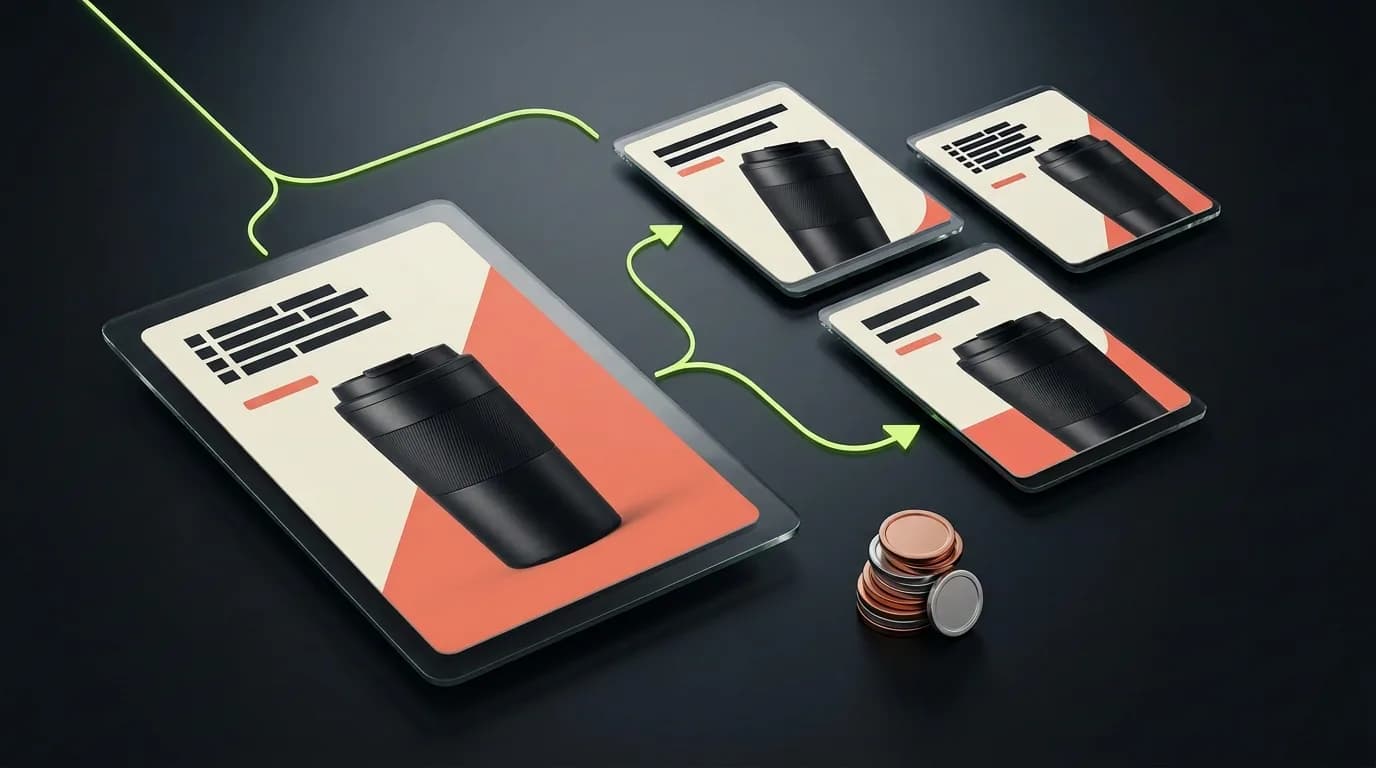
A control is the ad you already believe in. Every challenger is compared with it, and each challenger changes one meaningful thing: the angle, the visual style, the headline, or the offer.
Meta's A/B testing tool is built for this. According to Meta's A/B testing page, it divides people into random, non-overlapping groups, a test variable is one change while the rest of the setup stays the same, and an adequate budget is needed for an even split and a confident result. You create a test in Ads Manager or in Experiments, and a test can include up to five ad variants. Without the tool, the page says the system blends campaigns instead of splitting them evenly, which skews delivery.
That is the reason to keep the number of challengers low on a small budget. A control plus two or three challengers is easier to fund and easier to read than a control plus nine.
The budget formula
Decide the numbers before you launch.
- Total test budget (T): the most ad spend you are willing to put into this round.
- Number of ads (N): the control plus your challengers.
- Budget per ad: T divided by N, ideally equal across ads.
- Minimum evidence per ad (E): the least number of results (clicks, or conversions if you have the volume) you want before you compare. Choose a number that suits your conversion rate and write it down.
- Check: can each ad plausibly reach E at its share of the budget?
If the answer to step 5 is no, cut N or raise T. Do not launch ads you already know cannot reach your own evidence bar. Check Meta's current minimum budget requirements in your account, since they vary and change.
This is ad spend, which you pay to Meta. It is separate from the credits you spend on creative in HeyUGC, covered below.
Round one: a control and a few challengers
Start from one ad you already have, or the strongest ad you can make. Then add challengers that differ in one meaningful way each.
An angle is the one reason a particular person should care. A visual style is how the ad looks. HeyUGC's homepage gallery groups creatives as product, lifestyle, and typography, which gives you three recognizable styles to vary.
A product example
Invented product: Lidwell, a travel mug with a locking lid.
| Ad | What changes from the control | What stays the same |
|---|---|---|
| Control | Angle: it will not leak in a bag. Style: product on a plain background | |
| Challenger 1 | Style: lifestyle (the mug in a commute) | Angle, headline, primary text, audience |
| Challenger 2 | Angle: replaces daily takeaway cups | Style, audience, placement |
A software or service example
Invented business: Tallyboard, an invoicing app for freelancers. The same method applies to a service such as bookkeeping.
| Ad | What changes from the control | What stays the same |
|---|---|---|
| Control | Angle: stop chasing late payments. Style: typography-led | |
| Challenger 1 | Style: an image of the invoice screen | Angle, headline, primary text, audience |
| Challenger 2 | Angle: send invoices in a minute | Style, audience, placement |
Notice that each challenger touches one thing. If a challenger changes both the angle and the style, a difference tells you little about which one mattered.
Keep audience, placement, and budget per ad the same, and launch together through the A/B tool where you can.
Read round one before you make round two
Do not produce or schedule the next round until you have the first result. What you learn decides what to try next, and making second-round creative in advance often means paying for variations of an idea that did not work.
| What round one shows | Next move |
|---|---|
| A challenger clearly ahead of the control on your chosen metric | Make it the new control, then test one detail against it (headline, crop, color, or call to action) |
| The control ahead | Keep it. Try a different angle or style as the next challenger |
| No clear difference | Treat it as a tie. The thing you changed may not matter to this audience, so change something bigger or more different |
| Too few results to compare | Do not draw a conclusion. Raise the budget, reduce the number of ads, or run it longer |
For headline details, see our guide to writing five headline variants on one angle. Across several rounds you may reach ten different variations, each created because the last result suggested it.
Name every ad so you can read the results
Use a naming scheme from day one. When you open Ads Manager later, you should see at a glance what each ad was.
R1-CTRL-leak-product is round one, the control, the leak angle, product style. R1-C1-leak-lifestyle is round one, challenger one, lifestyle style. R2-C1-headline-scene is round two, challenger one, a scene headline.
Keep a log with the date, the budget, the metric, the change made, and the result for each ad.
Write the decision rule first
Before launching, finish this sentence and save it: "I will treat a challenger as better than the control if its [metric] is at least [amount] better, after each ad has reached [evidence bar], and I will treat anything closer as a tie."
Pick the metric that fits your goal.
| Goal | Primary metric | Watch also |
|---|---|---|
| Traffic | Cost per click | Quality of the visits |
| Leads | Cost per lead | Lead quality |
| Sales | Cost per purchase | Order value |
A rule written after the results arrive tends to shape itself around the ad you already like.
Be honest about what a small test can tell you
A small test gives you a signal, not a proof. Results from a small sample can swing, and Meta's tool reports a confidence estimate, not a certainty. A set number of days does not make a result reliable either. What helps is reaching your evidence bar and, where you can, covering whole weeks, since behavior varies by weekday. Treat close results as ties, and repeat a promising result before you scale spend on it.
Run the test cleanly
- Launch the control and challengers together, through the A/B tool where you can.
- Use the same audience and placement for every ad.
- Do not edit ads or switch them on and off mid-test. Changes make results harder to compare. Treat any change as a new test.
- Preview each placement. A 4:5 image and a 9:16 placement crop differently. Our guide on turning a website URL into on-brand ad images covers how HeyUGC image shapes sit against Meta's recommendations.
- Check every ad before launch. Every word on an image is a claim.
Producing the images in credits
Credits are the creative budget, paid to HeyUGC, and they are separate from ad spend. HeyUGC prices an image at 40 credits and an ad copy run at 6, per the pricing page. Because you make challengers one round at a time, you spend credits as the test unfolds instead of up front.
| Round | Images to make | Credits if each takes 1 run | Credits if each takes 2 runs |
|---|---|---|---|
| Round 1 (control already exists, 2 challengers) | 2 | 80 | 160 |
| Round 1 (no existing control, control plus 2 challengers) | 3 | 120 | 240 |
| Each later round of 2 challengers | 2 | 80 | 160 |
| An ad copy run for new headlines | 6 | 6 per run |
Reaching ten different variations across several rounds would take roughly 360 to 400 credits (nine or ten new images) if every run is a keeper, and roughly 720 to 800 if each image takes two runs. Your real cost per usable image depends on how many reruns you need, and "Generate again" uses credits again. The $10 pack gives 500 credits and the $20 pack gives 1,100, so a first round is well inside the smallest pack. Our credit breakdown explains the arithmetic.
To save credits, choose your references before you run, write a one-sentence idea line for each concept, and review your brand profile once at the start. Credits never expire, according to the pricing page, so you can hold the rest until round one gives you a direction.
Common mistakes
- Ten near-identical ads. They feel like a big test and read like none.
- Changing two things at once. You will not know which one worked.
- Making round two before round one is read. You pay for ideas that may be wrong.
- Calling a winner on day one. Early results swing.
- Chasing a tiny gap. A small difference at low volume is a tie.
- Judging an informal comparison as if it were controlled. Delivery in one ad set is not equal.
- Skipping the log. In a month you will not remember why you made the choice you did.
Frequently asked questions
How much budget do I need to test ads?
It depends on your cost per result and your evidence bar. Work backwards: how many results you need per ad, times what each result costs, times the number of ads.
Should I really test only two or three challengers?
On a small budget, yes. Fewer ads means more spend per ad and a result you can read. Meta's tool supports more, but your budget decides what you can afford.
How long should I run the test?
Until each ad has reached the evidence bar you set before launch. A fixed number of days does not guarantee a reliable result.
Can I use AI-generated images for testing?
Yes. Producing a few distinct concepts quickly is where they help most. Check every image for accuracy, the logo, and claims before it goes live.
What if two ads tie?
Treat them as equal. Keep the one that is cheaper to produce, or keep both and test something else.
Plan your first round
Pick your control, choose one meaningful change for each challenger, and fill in the budget formula. If you cannot fund each ad to your evidence bar, cut the number of ads. To make the creative, start at the HeyUGC homepage, add your website, and generate your first challenger.